

🍽️ The $612 Dinner, the $9 Tip, and the Note That Started a Debate
A restaurant bill can sometimes be more than just a receipt—it can become the beginning of a much bigger conversation.
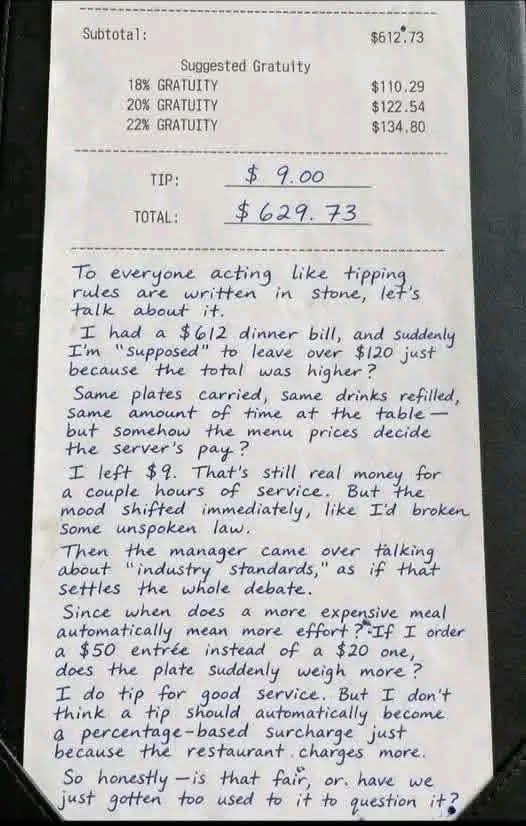
One customer recently left a handwritten note after receiving a $612.73 dinner bill. The receipt displayed suggested gratuities of 18%, 20%, and 22%, which would have amounted to more than $100. Instead, she left $9 and wrote a long explanation questioning whether a server should automatically receive a much larger tip simply because the restaurant’s menu prices are higher.
Her note raised a familiar question:
Should restaurant tipping be based on the price of the meal, the amount of work involved, the quality of service, or some combination of all three?
Some people understood her argument. Others felt that leaving only $9 on a $612 bill was disrespectful to the server.
Let’s break down the story, the reasoning behind the note, and why it created such a strong reaction.
🧾 Ingredients
For this thought-provoking “recipe,” you’ll need:
- 1 restaurant bill totaling $612.73
- 1 suggested gratuity section
- 1 handwritten $9 tip
- 1 long explanation
- A generous serving of disagreement
- A little frustration
- Different opinions about tipping culture
- A willingness to see both sides
- Plenty of conversation
- And, most importantly, respect for restaurant workers and customers alike
🥄 Instructions
Step 1: Look at the bill
The receipt showed:
- Subtotal: $612.73
- 18% gratuity: $110.29
- 20% gratuity: $122.54
- 22% gratuity: $134.80
- Tip left: $9
- Total paid: $629.73
That means the customer left approximately 1.5% of the bill as a tip.
That’s dramatically below the percentages suggested on the receipt.
Step 2: Read the customer’s reasoning
The customer argued that a more expensive meal doesn’t necessarily require proportionally more work from the server.
Her basic point was:
If a server carries a $50 plate to the table, and another server carries a $20 plate to the table, the physical act of serving those meals isn’t necessarily different.
Likewise, if two tables receive similar attention, drinks, refills, and service, the customer questioned why one server should automatically receive substantially more money simply because the food ordered was more expensive.
It’s a legitimate question about how percentage-based tipping works.
🍴 Method: Understanding Both Sides
The customer’s side
The strongest part of her argument is that price and labor aren’t always directly proportional.
Imagine two customers receiving essentially identical service.
Customer A spends $100.
Customer B spends $500.
If both customers receive the same level of attention, the traditional percentage system produces dramatically different tips.
At 20%:
- $100 meal → $20 tip
- $500 meal → $100 tip
The server didn’t necessarily perform five times as much work for the second customer.
That’s the economic question the note is trying to raise.
And there’s another important point: a tip is generally intended to recognize service, so it’s understandable that someone might think quality of service should matter more than the price of the food.
🧂 Method: Understanding the Waiter’s Side
Now comes the other perspective.
Restaurant workers may depend heavily on gratuities as part of their income. A server working a large table may spend considerable time taking orders, explaining menu items, coordinating with the kitchen and bar, checking on guests, refilling drinks, clearing plates, handling special requests, and managing the table throughout the meal.
A $600 dinner can also involve a larger party, more courses, more dishes, more drinks, and substantially more interaction than a small inexpensive meal.
So although the price of an entrée doesn’t automatically mean more work, a large restaurant bill can sometimes correspond with a more demanding service experience.
And from the server’s perspective, seeing a $612 bill followed by a $9 tip could understandably feel insulting—especially if the service was good.
🥄 Method: Was the Note Necessary?
This is where the discussion becomes more complicated.
The customer wasn’t required to accept the suggested 18%, 20%, or 22% amounts simply because they were printed on the receipt.
Suggested gratuity is not the same thing as a mandatory gratuity.
She was entitled to make her own decision about the amount.
But there’s a difference between choosing a small tip and leaving a lengthy written criticism explaining why the tipping system is wrong.
The note probably felt personal to the restaurant staff.
If the customer believed the service was poor, a short explanation describing what went wrong would have been much more directly connected to the actual experience.
Instead, the note challenged the broader culture of percentage-based tipping.
That’s likely why emotions became stronger.
📜 A Little History of Tipping
Tipping has a complicated history, particularly in the United States.
What began as a practice associated with certain forms of service eventually became deeply integrated into restaurant culture.
Over time, tipping became connected not only with gratitude but also with workers’ compensation.
That created a system where customers became an important part of determining a worker’s income.
Today, people continue to debate whether restaurants should simply pay higher wages and reduce reliance on tipping, whether percentage tipping should remain, or whether other models would work better.
So the customer’s note isn’t really just about one $9 tip.
It’s part of a much larger debate about how restaurant workers should be compensated.
🍽️ Formation: Why the $9 Tip Caused Such a Reaction
The biggest reason the story became controversial is the enormous difference between the bill and the tip.
A $9 tip on a $60 meal might look ordinary.
A $9 tip on a $612 meal sends a very different message.
Even if the customer’s argument about percentage tipping is understandable, the amount can easily be interpreted as saying:
“Your service was worth almost nothing.”
That may not have been what she intended.
But that’s how a tip can be perceived by the person receiving it.
This is an important lesson in restaurant etiquette: the meaning of a gesture isn’t always identical to the intention behind it.
❤️ What Could Have Been Done Differently?
If she wanted to make the same argument without creating as much conflict, she could have simply left a reasonable amount and discussed the issue separately.
For example:
“I appreciated the service, but I have concerns about percentage-based tipping on very expensive meals. I don’t believe the cost of the food should automatically determine the value of the service.”
That communicates the same philosophical argument without making the individual server feel personally punished for the restaurant’s pricing structure.
On the other hand, if the service was genuinely poor, she could have explained exactly what went wrong.
Specific feedback is generally more useful than a broad criticism of the entire tipping system.
🥄 Another Method: Separate the Food Price From the Service
This is probably the most interesting question raised by the note.
Consider two tables.
Table A
Food and drinks: $100
Service: excellent
Table B
Food and drinks: $500
Service: excellent
Should the second server automatically receive five times as much?
There’s no universal mathematical answer.
A percentage-based system says yes, roughly.
A fixed-tip system says not necessarily.
A service-quality approach might say the amount should depend primarily on the experience.
Different people will reach different conclusions because they’re using different definitions of what a tip represents.
💬 For the Lovers of Restaurant Debates
For people who love discussing restaurant etiquette, this story has almost everything:
🍽️ A huge dinner bill
💵 A surprisingly small tip
📝 A handwritten note
😬 An unhappy waiter
🤔 A legitimate question about tipping
🔥 And two completely different perspectives
Some readers will say:
“She had every right to leave whatever she wanted.”
Others will say:
“If the service was good, $9 on a $612 bill is disrespectful.”
And others will focus on the bigger issue:
“Maybe percentage-based tipping doesn’t make sense for extremely expensive meals.”
All three reactions can exist at the same time.
❤️ Conclusion
Was she wrong to question percentage-based tipping?
Not necessarily. Her question about whether the cost of food should automatically determine the value of service is reasonable and worth discussing.
Was leaving only $9 likely to upset the waiter?
Absolutely understandable. On a $612.73 bill, $9 is a very small gratuity compared with the suggested amounts printed on the receipt.
The most important distinction is between criticizing a system and criticizing an individual worker.
The customer was questioning the system.
The waiter may have experienced the tip as a judgment of his or her individual service.
And that’s probably where the disagreement became so heated.
In the end, this isn’t really just a story about nine dollars.
It’s about what a tip is supposed to represent: gratitude, compensation, service quality, social expectation, or some combination of all four.
And that’s exactly why this little handwritten note has people arguing.
🍴 Final Thoughts for the Lovers of Good Food & Good Service
A restaurant bill should ideally end with a satisfied customer, a fairly compensated worker, and no hard feelings.
But as long as tipping remains part of restaurant culture, debates like this will continue.
So now the question goes to everyone reading:
If you received excellent service on a $612 dinner, would you calculate your tip by percentage—or would you base it on the actual work the server did?
That’s where the real debate begins.