

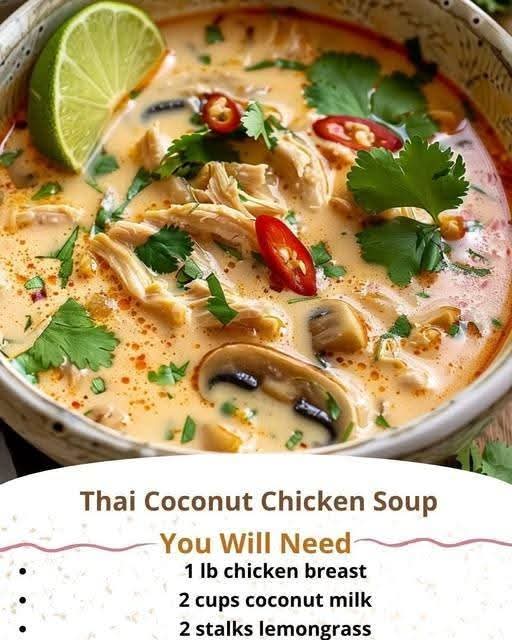
Thai Coconut Chicken Soup
Tom Kha Gai — Creamy Thai Coconut Chicken Soup
Introduction
Thai Coconut Chicken Soup, commonly known as Tom Kha Gai, is one of Thailand’s most beloved soups. It combines tender chicken with creamy coconut milk, aromatic lemongrass, galangal, makrut lime leaves, chilies, mushrooms, and fresh lime juice.
Unlike a heavy cream-based soup, Tom Kha Gai gets its luxurious texture from coconut milk. The soup is simultaneously creamy, tangy, savory, aromatic, mildly sweet, and spicy.
The magic comes from balance. Coconut milk softens the heat of the chilies, lime juice provides acidity, fish sauce contributes saltiness and umami, while lemongrass, galangal, and lime leaves provide the distinctive Thai fragrance.
Recipe Overview
Name: Tom Kha Gai
Meaning: Tom = to boil, Kha = galangal, Gai = chicken
Cuisine: Thai
Category: Soup
Preparation time: 20 minutes
Cooking time: 25–30 minutes
Total time: About 50 minutes
Servings: 6
Difficulty: Easy to moderate
Nutritional Information
Approximate nutrition per serving, assuming 6 servings:
| Nutrient | Approximate amount |
|---|---|
| Calories | 350–420 kcal |
| Protein | 25–30 g |
| Carbohydrates | 10–15 g |
| Fat | 24–30 g |
| Saturated fat | 18–23 g |
| Fiber | 2–3 g |
| Sugar | 4–6 g |
| Sodium | 800–1,200 mg |
The exact values vary according to the coconut milk, fish sauce, chicken, and amount of added sugar.
Note: Fish sauce and curry paste can be quite salty, so adjust them gradually.
Ingredients
Main Ingredients
- 1½ lb (680 g) boneless, skinless chicken thighs
- 1 tablespoon vegetable oil or neutral cooking oil
- 1 can (13.5–14 oz / 400 ml) full-fat coconut milk
- 3 cups (720 ml) chicken broth
- 8 oz (225 g) mushrooms, sliced
- 1 medium shallot, thinly sliced
- 3 cloves garlic, lightly crushed
- 1–2 Thai bird’s-eye chilies, sliced
- 2 tablespoons Thai red curry paste, optional
- 1 tablespoon brown sugar or palm sugar
- 2–3 tablespoons fish sauce
- 2–3 tablespoons fresh lime juice
Aromatic Ingredients
Lemongrass
Use:
- 2 stalks lemongrass
Trim the tough ends.
Lightly crush the stalks with the side of a knife.
Cut them into large pieces.
Galangal
Use:
- 1½–2 oz (40–55 g) fresh galangal
Slice it thinly.
Galangal is traditionally used in Tom Kha Gai and has a sharper, more peppery and aromatic flavor than ordinary ginger.
Makrut Lime Leaves
Use:
- 5–6 makrut lime leaves
Tear or gently crush them before adding.
They provide a distinctive citrus fragrance.
Garnish
Prepare:
- Fresh cilantro
- Thinly sliced green onions
- Extra sliced chilies
- Fresh lime wedges
- A few cilantro leaves
- Optional toasted coconut flakes
Optional Ingredients
You can also include:
- Baby corn
- Cherry tomatoes
- Snow peas
- Bell pepper
- Bamboo shoots
- Straw mushrooms
- Oyster mushrooms
- Thai basil
- Fresh ginger if galangal isn’t available
- A small amount of chili oil
History of Tom Kha Gai
Tom Kha Gai is a traditional Thai soup whose name describes its main characteristics.
Tom refers to boiling or simmering.
Kha refers to galangal.
Gai means chicken.
So the name essentially describes a boiled/simmered chicken soup featuring galangal.
The dish belongs to Thailand’s broader culinary tradition of balancing contrasting flavors rather than emphasizing only one dominant taste.
Thai cuisine frequently combines:
- Sour
- Salty
- Sweet
- Spicy
- Savory
- Aromatic
Tom Kha Gai demonstrates this beautifully.
The creamy coconut milk gives the soup richness while lime and aromatic herbs keep it bright and refreshing.
Over time, different regions, restaurants, and households developed their own versions. Some use more coconut milk, others more broth. Some include chili paste or roasted chili oil, while others keep the soup relatively mild and pale.
Formation of the Soup
The soup is built in several stages.
First: Aromatic Broth
Lemongrass, galangal, and makrut lime leaves are simmered in broth.
This extracts their fragrance without requiring them to be eaten.
Second: Chicken
Chicken is added and gently cooked until tender.
Third: Mushrooms
Mushrooms provide an earthy, meaty texture.
Fourth: Coconut Milk
Coconut milk creates the creamy body of the soup.
Fifth: Seasoning
Fish sauce, sugar, chilies, and lime juice establish the Thai flavor balance.
Final: Fresh Garnishes
Cilantro, green onion, chilies, and lime brighten the finished soup.
Instructions
Step 1: Prepare the Chicken
Cut the chicken thighs into thin, bite-sized pieces.
Chicken thighs are especially good for this soup because they remain juicy and tender.
You can use chicken breast, but be careful not to overcook it.
Step 2: Prepare the Aromatics
Trim the lemongrass.
Lightly crush it using the side of your knife.
Slice the galangal.
Gently tear the makrut lime leaves.
Crush the garlic.
Slice the chilies.
Don’t chop the lemongrass, galangal, and lime leaves too finely.
You’ll want to remove them later.
Step 3: Build the Aromatic Broth
Place a large pot over medium heat.
Add:
- Chicken broth
- Lemongrass
- Galangal
- Makrut lime leaves
- Garlic
- Shallot
Bring everything to a gentle simmer.
Allow the aromatics to simmer for approximately 10 minutes.
This is where the soup begins developing its distinctive fragrance.
Step 4: Add the Chicken
Add the sliced chicken.
Stir gently.
Simmer for approximately 5–8 minutes, depending on the thickness of the pieces.
Don’t boil aggressively.
A gentle simmer keeps the chicken tender.
Step 5: Add the Mushrooms
Add the sliced mushrooms.
Simmer for another 4–5 minutes.
The mushrooms should become tender but not mushy.
Step 6: Add Coconut Milk
Reduce the heat to medium-low.
Pour in the coconut milk.
Stir gently.
Allow the soup to become hot but avoid a vigorous boil.
This helps maintain the smooth, creamy texture of the coconut milk.
Step 7: Add Curry Paste
If you’re using Thai red curry paste, add:
1–2 tablespoons.
Stir until fully incorporated.
Curry paste isn’t necessary for every version of Tom Kha Gai, but it adds:
- Color
- Chili heat
- Aromatic complexity
- Deeper savory flavor
Step 8: Add Fish Sauce and Sugar
Add:
- 2 tablespoons fish sauce
- 1 tablespoon palm sugar or brown sugar
Stir.
Taste.
Add additional fish sauce if necessary.
The sugar isn’t supposed to make the soup taste sweet. It simply balances the acidity, saltiness, and spice.
Step 9: Add Chilies
Add sliced Thai chilies according to your preferred spice level.
For mild soup:
1 chili
For medium:
2–3 chilies
For spicy:
3–5 chilies
Remember that the heat can intensify as the soup sits.
Step 10: Add Lime Juice
Turn the heat down or remove the pot from the burner.
Add fresh lime juice.
Start with:
2 tablespoons.
Taste.
Add another tablespoon if you want a sharper, more sour flavor.
Important:
Don’t boil the lime juice for a long time.
Adding it toward the end preserves its fresh citrus character.
Step 11: Taste and Balance
This is the most important stage.
Taste your soup carefully.
You want a balance of:
Creamy + sour + salty + savory + spicy + slightly sweet.
If it’s too salty:
Add more coconut milk or broth.
If it’s too rich:
Add more lime juice and broth.
If it’s too sour:
Add a tiny amount of sugar.
If it’s too mild:
Add chilies or curry paste.
If it lacks savory depth:
Add a little fish sauce.
Step 12: Finish With Fresh Herbs
Turn off the heat.
Add chopped cilantro and green onions.
Give the soup one gentle stir.
Step 13: Serve
Ladle the hot soup into bowls.
Garnish with:
- Fresh cilantro
- Sliced chili
- Green onion
- Lime wedge
Serve immediately.
Traditional Cooking Method
For the most aromatic version:
- Simmer broth with lemongrass.
- Add galangal.
- Add makrut lime leaves.
- Add shallot and garlic.
- Add chicken.
- Add mushrooms.
- Add coconut milk.
- Season with fish sauce and sugar.
- Add chilies.
- Finish with lime juice.
- Garnish with fresh herbs.
This gradual approach gives the broth plenty of time to absorb the aromatics.
Quick Weeknight Method
If you’re short on time:
- Heat chicken broth.
- Add lemongrass, galangal, and lime leaves.
- Simmer 5–7 minutes.
- Add chicken.
- Add mushrooms.
- Add coconut milk.
- Add curry paste.
- Season with fish sauce and sugar.
- Simmer until chicken is cooked.
- Turn off heat.
- Add lime juice.
- Garnish.
You can have a delicious bowl ready in approximately 30 minutes.
Slow-Simmer Method
For deeper flavor, make the aromatic broth first.
Simmer:
- Broth
- Lemongrass
- Galangal
- Lime leaves
- Garlic
- Shallot
for approximately 15–20 minutes.
Strain the broth if you want a cleaner soup.
Return the broth to the pot.
Then add the chicken, mushrooms, coconut milk, and seasonings.
This produces an exceptionally fragrant broth.
Important Tip: Don’t Boil Coconut Milk Aggressively
Coconut milk is best treated gently.
A hard boil can make the soup look oily or separated.
Keep the temperature around a gentle simmer.
The soup should be hot and steaming without violently bubbling.
What Makes Tom Kha Gai Different?
Tom Kha Gai is sometimes confused with Tom Yum.
The major difference is that Tom Kha Gai traditionally includes a generous amount of coconut milk, giving it a creamy body.
Tom Yum is generally sharper, more intensely sour and spicy, and usually has a clearer broth.
Tom Kha Gai is:
Creamier + richer + milder + coconut-forward.
Tom Yum is often:
Sharper + brighter + hotter + more intensely sour.
How to Make It More Authentic
For a more traditional flavor profile, prioritize:
Fresh galangal
This is one of the defining aromatics.
Fresh lemongrass
Fresh stalks provide much better fragrance than dried alternatives.
Makrut lime leaves
These provide a very distinctive citrus aroma.
Fresh lime juice
Add it at the end.
Fish sauce
This provides the characteristic salty umami flavor.
Full-fat coconut milk
It gives the soup its luxurious texture.
Chicken Options
Chicken Thigh
Best for richness and tenderness.
This is my preferred choice.
Chicken Breast
Lean and high in protein, but easier to overcook.
Slice thinly and simmer gently.
Shredded Chicken
Excellent if you already have cooked chicken.
Add it near the end so it doesn’t become dry.
Mushroom Lovers’ Version
If you’re a mushroom lover, increase the amount to:
12–16 oz mushrooms.
Use a mixture of:
- Shiitake
- Oyster mushrooms
- Button mushrooms
- Straw mushrooms
The combination creates a deeper, more complex texture.
Spicy Tom Kha Gai
For a fiery version:
- Add 3–5 Thai chilies.
- Add 1 extra tablespoon red curry paste.
- Add a little chili oil.
Serve with additional sliced chilies.
For maximum heat, crush some chilies into the broth rather than simply floating them on top.
Mild Family Version
For children or people who don’t like spicy food:
- Omit the Thai chilies.
- Reduce curry paste.
- Serve chili separately.
- Increase coconut milk slightly.
The soup will remain flavorful because the lemongrass, galangal, lime leaves, fish sauce, and lime provide plenty of character.
Serving Suggestions
Tom Kha Gai is excellent with:
- Jasmine rice
- Steamed rice
- Thai sticky rice
- Rice noodles
- Fresh cucumber salad
- Stir-fried vegetables
- Spring rolls
A bowl of jasmine rice is especially good because it absorbs the creamy coconut broth.
Storage
Allow leftovers to cool reasonably quickly and refrigerate in an airtight container.
Store for approximately 3–4 days.
When reheating, use medium-low heat.
Avoid a violent boil.
If the soup becomes too thick in the refrigerator, add a little chicken broth or water while reheating.
Freezing
Tom Kha Gai can be frozen, although coconut milk may change texture slightly after thawing.
For best results:
- Cool the soup.
- Place it in freezer-safe containers.
- Leave some space for expansion.
- Freeze.
- Thaw overnight in the refrigerator.
- Reheat gently.
- Add fresh lime juice and cilantro after reheating.
Fresh lime at the end can revive the flavor considerably.
Common Mistakes
Mistake 1: Using Too Much Lime
Lime should brighten the soup, not overpower it.
Add it gradually.
Mistake 2: Boiling the Coconut Milk
A gentle simmer is better.
Mistake 3: Adding Lime Too Early
Long cooking destroys some of its fresh character.
Mistake 4: Overcooking Chicken Breast
Slice it thinly and cook gently.
Mistake 5: Making It Too Sweet
Sugar should balance the soup rather than turn it into a sweet coconut soup.
Mistake 6: Not Tasting
Thai soups depend on balance.
Always taste before serving.
The Perfect Flavor Formation
A great Tom Kha Gai should develop in layers.
First flavor
You notice the rich coconut aroma.
Second flavor
The lemongrass and lime leaves provide citrusy freshness.
Third flavor
Galangal gives the soup a warm, earthy, peppery character.
Fourth flavor
Fish sauce contributes savory umami.
Fifth flavor
Lime adds a bright sour note.
Final flavor
Chili leaves a pleasant warmth.
This layering is what makes the soup so addictive.
Thai Coconut Chicken Soup Lovers
This soup is perfect for coconut lovers because the coconut milk creates a rich, creamy broth without needing dairy cream.
It’s ideal for spice lovers because Thai chilies can be adjusted from mild to fiery.
It’s wonderful for chicken lovers because tender chicken absorbs all the aromatic flavors.
And it’s especially satisfying for soup lovers because every spoonful contains a combination of creamy broth, tender meat, mushrooms, herbs, and aromatic spices.
Restaurant-Style Finishing Touch
For a beautiful presentation, place several pieces of chicken and mushrooms in the bowl first.
Ladle the coconut broth around them.
Then garnish with:
- Cilantro
- Green onion
- Thinly sliced chili
- A few drops of chili oil
- Lime wedge
Finish with a small drizzle of coconut milk if desired.
The contrasting colors make the soup look incredibly appetizing.
Conclusion
Thai Coconut Chicken Soup, or Tom Kha Gai, is a beautiful example of Thai culinary balance.
It combines creamy coconut milk, tender chicken, earthy mushrooms, fragrant lemongrass, galangal, makrut lime leaves, spicy chilies, salty fish sauce, and bright lime juice into one unforgettable bowl.
The secret isn’t simply adding lots of ingredients. The secret is balancing them.
You want enough coconut milk to provide richness, enough lime to create brightness, enough fish sauce to provide savory depth, enough sugar to smooth the edges, and enough chili to give the soup a pleasant kick.
For the ultimate Tom Kha Gai lovers, serve it piping hot with jasmine rice, fresh cilantro, extra lime, and chilies on the side.
Creamy, aromatic, spicy, sour, savory, and comforting — this is a soup that can turn an ordinary dinner into something truly special.