

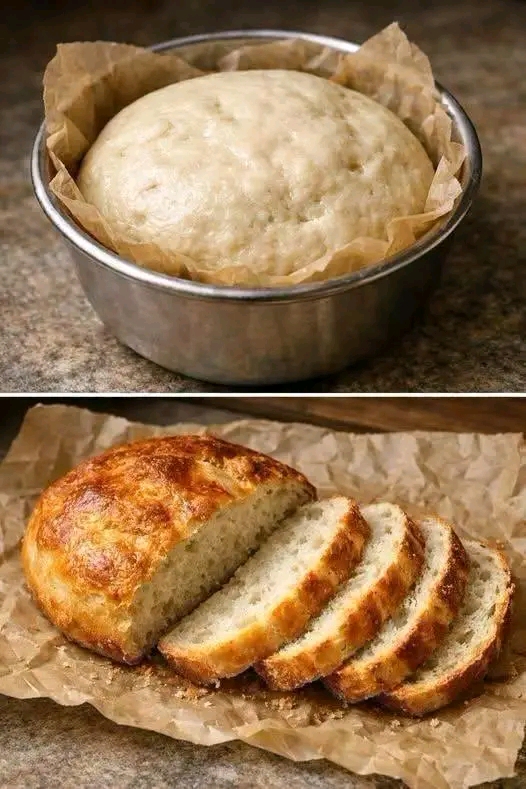
🍞 No-Flour, No-Sugar Bread
Introduction
If you’re looking for homemade bread without traditional flour and without added sugar, this recipe is a wonderful place to start. It uses eggs, almond flour, ground flaxseed, and psyllium husk to create a loaf with a soft interior, a slightly nutty flavor, and enough structure to slice for breakfast, sandwiches, or snacks.
Unlike conventional bread, this loaf doesn’t depend on wheat flour, yeast, or added sugar. Instead, the eggs provide structure, the almond flour gives richness, flaxseed contributes texture, and psyllium husk helps bind everything together.
Note: Although this is commonly called “no-flour bread,” almond flour and ground flaxseed are still ground plant ingredients. This recipe is wheat-flour-free rather than literally free of all flour-like ingredients.
🍞 Recipe at a Glance
Yield: 1 loaf, about 10 slices
Prep time: 10 minutes
Resting time: 5–10 minutes
Baking time: 40–50 minutes
Total time: About 1 hour
Difficulty: Easy
Texture: Soft, moist, slightly dense
Flavor: Mildly nutty and savory
🥚 Ingredients
Main ingredients
- 1½ cups almond flour
- ½ cup ground flaxseed
- 2 tablespoons psyllium husk powder
- 1 teaspoon baking powder
- ½ teaspoon baking soda
- ½ teaspoon salt
- 4 large eggs
- ¼ cup extra-virgin olive oil
- ½ cup unsweetened almond milk or water
- 1 teaspoon apple cider vinegar
- 1 teaspoon lemon juice, optional
Optional additions
For extra flavor, you can add:
- 1 tablespoon sesame seeds
- 1 tablespoon sunflower seeds
- 1 tablespoon pumpkin seeds
- 1 teaspoon dried oregano
- ½ teaspoon garlic powder
- 1 tablespoon chia seeds
- A small handful of chopped walnuts
No sugar is added to this recipe.
🧰 Equipment
You’ll need:
- 8 × 4-inch or similar loaf pan
- Mixing bowl
- Whisk
- Spatula
- Measuring cups and spoons
- Parchment paper
- Wire cooling rack
👩🍳 Instructions
Step 1: Prepare the Oven
Preheat your oven to:
350°F / 175°C
Line your loaf pan with parchment paper, leaving a little paper hanging over the sides. This makes removing the bread much easier.
Step 2: Mix the Dry Ingredients
In a large bowl, combine:
- Almond flour
- Ground flaxseed
- Psyllium husk
- Baking powder
- Baking soda
- Salt
Whisk thoroughly.
Make sure the psyllium husk is distributed evenly because it absorbs liquid and helps create the bread’s structure.
Step 3: Mix the Wet Ingredients
In a second bowl, whisk together:
- Eggs
- Olive oil
- Almond milk or water
- Apple cider vinegar
- Lemon juice, if using
Whisk until the mixture is smooth.
🥣 Step 4: Combine Everything
Slowly pour the wet mixture into the dry ingredients.
Stir with a spatula until everything is incorporated.
The batter will become noticeably thicker as the flaxseed and psyllium absorb liquid.
Don’t worry if it doesn’t resemble traditional bread dough.
⏳ Step 5: Let the Mixture Rest
Allow the mixture to sit for approximately 5–10 minutes.
This is an important step.
The psyllium husk and flaxseed will absorb moisture and transform the loose batter into a thicker, bread-like mixture.
If the mixture becomes extremely thick, add 1 tablespoon of water at a time until it becomes thick but spreadable.
🍞 Step 6: Transfer to the Pan
Spoon the mixture into your prepared loaf pan.
Smooth the surface with a spatula.
For a beautiful bakery-style appearance, sprinkle the top with:
- Sesame seeds
- Sunflower seeds
- Pumpkin seeds
Gently press them into the surface.
🔥 Step 7: Bake
Place the loaf in the center of the preheated oven.
Bake for approximately:
40–50 minutes
The bread should become golden brown and firm.
A toothpick inserted into the center should come out mostly clean.
If the top is becoming too brown before the center is finished, loosely cover the loaf with aluminum foil during the final part of baking.
❄️ Step 8: Cool Completely
Remove the loaf from the oven.
Allow it to cool in the pan for approximately 10 minutes.
Then carefully lift it out using the parchment paper.
Transfer it to a wire rack.
Allow it to cool for at least 30–45 minutes before slicing.
This is extremely important.
If you slice the bread while it’s hot, the interior can appear wet or gummy because it hasn’t finished setting.
🔪 Step 9: Slice and Serve
Once completely cool, use a sharp serrated knife to cut the loaf into approximately 10 slices.
You can enjoy it:
- Toasted
- With avocado
- With eggs
- With cheese
- With hummus
- With tuna
- With turkey
- With vegetables
- With natural nut butter
🌾 Method
The method behind this bread is different from conventional yeast bread.
Traditional bread
Traditional bread generally relies on:
Wheat flour → gluten → yeast fermentation → rising → baking
This recipe instead uses:
Almond flour + flaxseed + eggs + psyllium → binding → baking
There is no need to knead the dough or wait for yeast fermentation.
🧬 How the Bread Forms
Each ingredient has an important job.
🥚 Eggs
Eggs provide proteins that coagulate during baking, helping the loaf become firm.
They also add moisture and richness.
🌰 Almond flour
Almond flour provides body, fat, protein, and a pleasant nutty flavor.
🌱 Flaxseed
Ground flaxseed absorbs liquid and contributes fiber and structure.
🌾 Psyllium husk
Psyllium is particularly useful in flour-free and gluten-free baking because it absorbs water and creates a gel-like structure.
This helps hold the loaf together.
🥛 Liquid
The almond milk or water hydrates the flaxseed and psyllium.
🫒 Olive oil
Olive oil contributes moisture and richness and helps prevent the loaf from becoming excessively dry.
🍋 Vinegar
The vinegar helps provide acidity for the leavening system and can also contribute to a lighter texture.
🧂 Salt
Salt enhances the flavor of the bread.
📊 Approximate Nutritional Information
Nutrition varies according to the exact brands and ingredients used.
For 1 slice if the loaf is divided into 10 slices, an approximate calculation is:
| Nutrient | Per slice |
|---|---|
| Calories | ~190–210 kcal |
| Protein | ~6–7 g |
| Fat | ~16–18 g |
| Carbohydrates | ~7–9 g |
| Fiber | ~4–5 g |
| Net carbs | ~3–4 g |
| Sugar | ~1 g or less |
| Added sugar | 0 g |
The bread is relatively calorie-dense because almond flour and olive oil contain significant amounts of fat.
❤️ For Bread Lovers
If you’re a true bread lover, the best thing about this recipe is its versatility.
For a breakfast loaf, add sesame seeds and sunflower seeds.
For a savory sandwich loaf, add oregano and garlic powder.
For a Mediterranean-style loaf, add oregano, rosemary, and chopped olives.
For a nutty loaf, add walnuts and pumpkin seeds.
For a toast-style loaf, simply slice it thinly and toast until golden and crisp.
🥑 Serving Ideas
Avocado Toast
Toast one slice and top with:
- Mashed avocado
- Salt
- Black pepper
- Lemon juice
- Chili flakes
Egg Breakfast
Toast the bread and serve with:
- Fried eggs
- Scrambled eggs
- Tomato
- Avocado
Nut Butter Toast
Spread natural almond or peanut butter over a toasted slice.
For a naturally sweet option, add sliced banana or berries without adding sugar to the bread itself.
Savory Sandwich
Use two slices with:
- Turkey or chicken
- Lettuce
- Tomato
- Cucumber
- Mustard
🥜 Variations
Seeded No-Flour Bread
Add:
- 2 tablespoons sunflower seeds
- 2 tablespoons pumpkin seeds
- 1 tablespoon sesame seeds
This gives the loaf a wonderfully crunchy exterior.
Garlic Herb Bread
Add:
- 1 teaspoon garlic powder
- 1 teaspoon dried oregano
- ½ teaspoon rosemary
This version is excellent toasted with olive oil.
Extra-Protein Version
Replace part of the almond milk with additional egg whites.
This can increase the protein content while reducing some of the fat.
Coconut Version
Replace a small portion of the almond flour with unsweetened coconut flour.
Important: coconut flour absorbs considerably more liquid than almond flour, so don’t substitute it cup-for-cup.
🧊 Storage
Allow the loaf to cool completely before storing.
Refrigerator
Place it in an airtight container or sealed bag.
It should keep for approximately 5–7 days.
Freezer
Slice the bread before freezing.
Place parchment between slices and store in a freezer-safe bag.
It can generally be frozen for approximately 2–3 months.
You can take out individual slices and toast them directly from frozen.
🔥 Toasting Method
One of the best ways to enjoy this bread is toasted.
Place a slice in a toaster or under a broiler until the edges become crisp.
The outside becomes crunchy while the inside remains soft.
Add avocado, eggs, cheese, or your favorite spread.
📜 A Little History
Bread has existed in many forms for thousands of years, but modern bread-making has traditionally centered around grains such as wheat, rye, barley, and oats.
Wheat became particularly important because its gluten-forming proteins can create an elastic network that traps gases produced during fermentation.
Modern gluten-free and grain-free baking has developed alternative techniques using ingredients such as eggs, nuts, seeds, flaxseed, and psyllium husk to recreate some of the structure traditionally provided by wheat.
This type of bread therefore belongs to a much newer family of alternative bread recipes rather than the ancient tradition of conventional wheat bread.
🌟 Why You’ll Love This Bread
❤️ No added sugar
There is no sugar, honey, maple syrup, or other sweetener in the basic recipe.
🌾 No wheat flour
There is no conventional wheat flour.
🥚 Simple preparation
There’s no yeast and no kneading.
🌱 High in fiber
Flaxseed and psyllium contribute substantial dietary fiber.
🥑 Versatile
It works for both sweet and savory toppings.
🍞 Great toasted
Toasting gives it a particularly satisfying texture.
⚠️ Important Tips for Success
Don’t skip the resting time.
The psyllium needs time to absorb liquid.
Don’t slice immediately.
Cooling allows the internal structure to finish setting.
Measure psyllium carefully.
Too much can make the bread extremely dense or dry.
Don’t expect traditional wheat bread.
This loaf will be more compact and nutty than conventional sandwich bread.
Use finely ground almond flour.
It produces a smoother texture than coarse almond meal.
🏆 Conclusion
This No-Flour, No-Sugar Bread is a simple alternative to conventional homemade bread. With almond flour, flaxseed, psyllium husk, eggs, and olive oil, you can create a satisfying loaf without wheat flour or added sugar.
Its greatest strength is its versatility. Toast it for breakfast, use it for sandwiches, serve it alongside soup, or top it with avocado and eggs.
For the best result, remember the three golden rules:
Mix thoroughly → let it rest → cool completely.
Once you master those steps, this easy homemade loaf can become a regular part of your kitchen routine. 🍞🌱🥑