

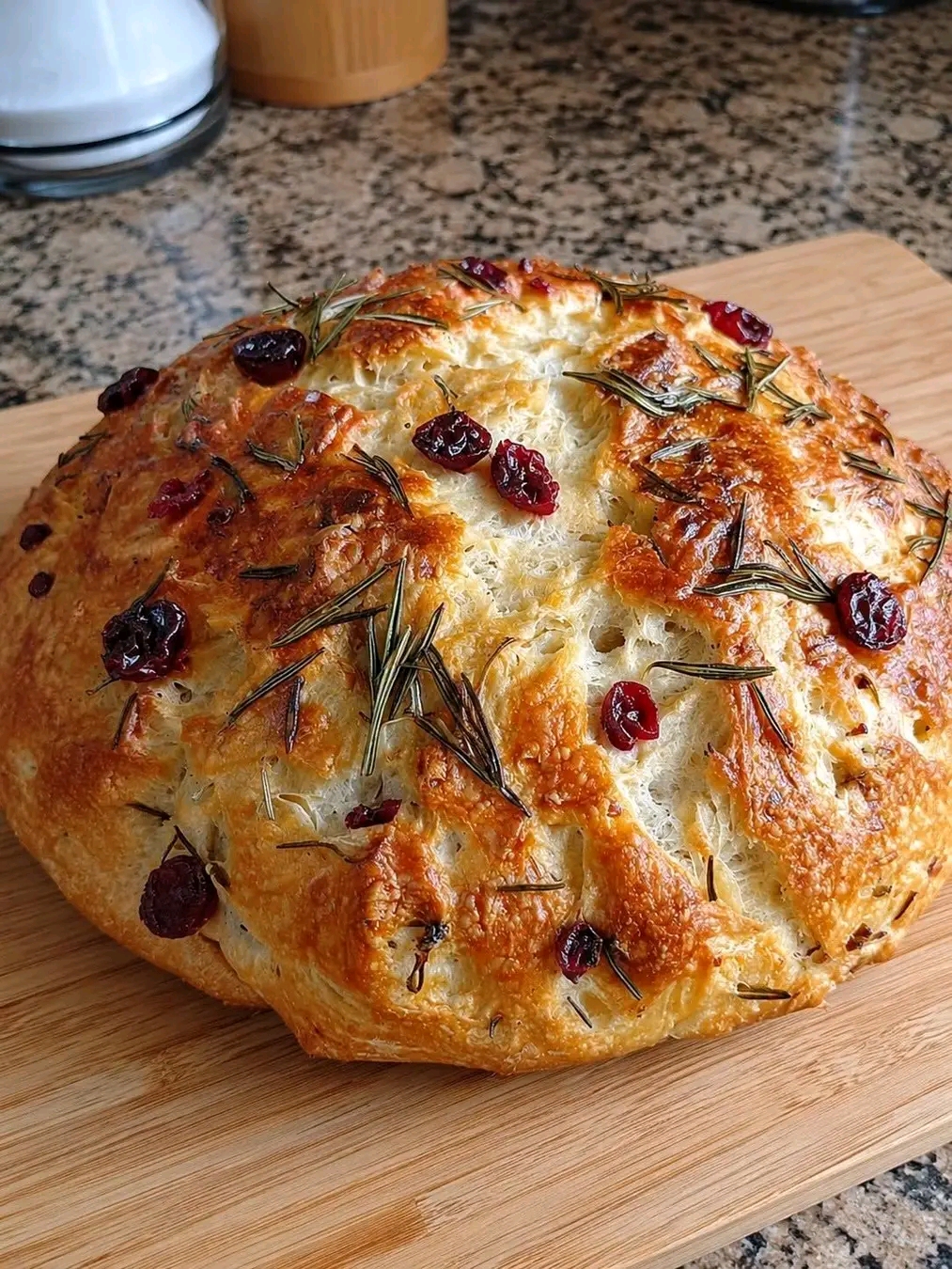
🌿 Low-Carb No-Knead Rosemary Cranberry Bread
A rustic, fragrant bread with rosemary, tart cranberry flavor, olive oil, and a golden crust—but redesigned to be much lower in carbohydrates than traditional no-knead bread.
Traditional no-knead bread normally relies on wheat flour and a long fermentation, which allows time rather than kneading to develop the dough’s structure. The classic rosemary-cranberry combination is also well established in artisan bread recipes, where dried cranberries and fresh rosemary provide a sweet-savory contrast.
Because almond and coconut flour do not behave like wheat flour, this low-carb version cannot reproduce exactly the same chewy gluten structure. Instead, eggs, xanthan gum, psyllium husk, and baking powder create a sliceable, moist, rustic crumb.
Servings: 10–12 slices
Prep time: 15 minutes
Resting time: 20–30 minutes
Baking time: 40–50 minutes
Total time: about 1 hour 15 minutes
Difficulty: Easy
Style: Low-carb, keto-friendly adaptation, no kneading
🍞 Introduction
Imagine slicing into a warm loaf and immediately getting the aroma of fresh rosemary, followed by little bursts of tart cranberry.
Traditional cranberry-rosemary bread is usually made with several cups of wheat flour. For example, a conventional no-knead version can contain around 3 cups of flour, dried cranberries, rosemary, yeast, salt, and water and then undergo a long overnight fermentation.
This recipe takes inspiration from that style but changes the foundation.
Instead of wheat flour, we use:
- 🌰 Almond flour
- 🥥 Coconut flour
- 🌾 Psyllium husk
- 🥚 Eggs
- 🫒 Olive oil
- 🌿 Fresh rosemary
- 🍒 A small amount of unsweetened or reduced-sugar dried cranberry
The result is a dense but tender artisan-style loaf with a crisp exterior and flavorful interior.
🥗 Nutritional Information
Approximate nutrition per slice when divided into 10 slices:
| Nutrient | Approximate amount |
|---|---|
| Calories | 170–200 kcal |
| Protein | 6–8 g |
| Total carbohydrates | 7–10 g |
| Fiber | 4–6 g |
| Net carbohydrates | 3–5 g |
| Fat | 14–16 g |
| Sugar | 2–4 g |
These numbers depend heavily on the almond flour, coconut flour and especially the cranberry product you use.
Important low-carb note
Regular dried cranberries are often heavily sweetened and can contain a substantial amount of added sugar. For a genuinely low-carb loaf, use unsweetened dried cranberries, a low-sugar cranberry product, or use only a small quantity.
A published keto-style cranberry-rosemary bread similarly uses almond flour and coconut flour as its low-carb foundation, along with xanthan gum, eggs, rosemary and olive oil.
🛒 Ingredients
Dry ingredients
- 2 cups (about 190–200 g) fine almond flour
- ½ cup (about 55–60 g) coconut flour
- 1 tbsp psyllium husk powder
- 1 tsp xanthan gum
- 2 tsp baking powder
- ½ tsp baking soda
- ¾ tsp fine sea salt
- 1–2 tbsp unsweetened dried cranberries, finely chopped
- 1½ tbsp fresh rosemary, finely chopped
Wet ingredients
- 4 large eggs
- ¼ cup (60 ml) extra-virgin olive oil
- ¾ cup (180 ml) warm water
- 1 tbsp apple cider vinegar
- 1 tsp lemon juice
- 1 tsp rosemary-infused olive oil, optional
For the top
- 1 tsp olive oil
- 1 tsp fresh rosemary
- A pinch of flaky sea salt
- A few finely chopped cranberries
🌿 Ingredient Formation
Almond flour
Almond flour provides the main body of the bread and contributes fat, protein and a moist crumb.
Coconut flour
Coconut flour absorbs considerably more liquid than wheat flour, so only a relatively small amount is necessary.
Psyllium husk
Psyllium helps bind the ingredients and gives the loaf a more bread-like structure.
Xanthan gum
Xanthan gum helps compensate for the lack of gluten and improves the loaf’s ability to hold together.
Eggs
Eggs provide structure and help the bread rise while baking.
Rosemary
Fresh rosemary gives the bread its distinctive herbal aroma.
Cranberries
Cranberries provide small bursts of tart sweetness. Because the recipe is low-carb, the amount is intentionally modest.
Olive oil
Olive oil adds richness and helps keep the crumb moist.
👨🍳 Instructions
Step 1 — Prepare the oven
Preheat your oven to:
375°F / 190°C
Line a loaf pan with parchment paper.
Leave enough parchment hanging over the sides so you can easily lift the finished loaf from the pan.
Step 2 — Chop the rosemary and cranberries
Finely chop the fresh rosemary.
Then chop the cranberries into small pieces.
This is important because large pieces can create weak spots in the loaf.
Set them aside.
Step 3 — Combine the dry ingredients
In a large bowl, combine:
- Almond flour
- Coconut flour
- Psyllium husk
- Xanthan gum
- Baking powder
- Baking soda
- Salt
Whisk thoroughly.
Make sure the xanthan gum and psyllium are distributed evenly.
Step 4 — Add the rosemary and cranberries
Add your chopped rosemary and cranberries.
Stir gently until they are evenly distributed throughout the dry mixture.
At this point, the mixture should smell intensely aromatic.
Step 5 — Mix the wet ingredients
In another bowl, whisk together:
- Eggs
- Olive oil
- Warm water
- Apple cider vinegar
- Lemon juice
Whisk for about 30–45 seconds.
The mixture should be smooth and uniform.
Step 6 — Combine everything
Slowly pour the wet mixture into the dry ingredients.
Using a wooden spoon or silicone spatula, stir until everything is incorporated.
Do NOT knead.
That’s the important part.
Traditional no-knead bread relies on a wet wheat dough and long fermentation to develop gluten without mechanical kneading.
This low-carb version doesn’t contain conventional gluten, so we’re simply mixing until the ingredients are fully hydrated.
The dough should resemble a very thick, sticky batter.
Step 7 — Let the mixture rest
Cover the bowl and let the mixture rest for approximately:
20–30 minutes
During this time, the coconut flour, psyllium and xanthan gum absorb moisture.
The dough will become noticeably thicker.
If it becomes extremely dry or crumbly, mix in 1 tablespoon of water at a time until it becomes cohesive.
Step 8 — Transfer to the pan
Spoon the dough into the prepared loaf pan.
Use a spatula to smooth the surface.
Don’t press it down aggressively.
You want the loaf to remain slightly airy.
Step 9 — Create the artisan topping
Brush the top lightly with olive oil.
Then sprinkle over:
- Fresh rosemary
- A few chopped cranberries
- Flaky sea salt
You can also make one shallow line down the center with a knife.
This helps give the loaf a more rustic appearance.
🔥 Step 10 — Bake
Place the loaf in the preheated oven.
Bake for approximately:
40–50 minutes at 375°F / 190°C
The top should become golden brown.
If the top begins browning too quickly, loosely cover it with aluminum foil for the remaining baking time.
🌡️ Step 11 — Check for doneness
The loaf should feel firm when gently pressed.
If you have an instant-read thermometer, aim for an internal temperature around 200–205°F (93–96°C).
The center should no longer feel wet.
❄️ Step 12 — Cool completely
Remove the bread from the pan using the parchment paper.
Place it on a wire rack.
Allow it to cool for at least 45–60 minutes before slicing.
This is especially important for low-carb bread.
Cutting it while extremely hot can make the center appear gummy because the internal structure has not fully set.
🔪 Step 13 — Slice
Use a sharp serrated knife.
Cut into approximately 10–12 slices.
For thicker slices, divide into 10.
For thinner toast-sized slices, divide into 12.
🌿 The No-Knead Method
The name “no-knead” traditionally refers to bread where time and fermentation replace extensive mechanical kneading. Long fermentation allows the gluten network to develop naturally.
The method became particularly famous in modern American home baking after Jim Lahey’s technique was popularized by Mark Bittman’s 2006 New York Times article. However, the history is considerably older: no-knead techniques have appeared in different forms for centuries, and Doris Grant was promoting no-knead whole-wheat bread decades before the modern revival.
Our low-carb adaptation uses the philosophy of no-kneading rather than trying to reproduce wheat-gluten fermentation.
📜 History of Rosemary & Cranberry Bread
The combination of rosemary and dried fruit makes culinary sense because it creates a balance between savory herbal flavor and sweet-tart fruit.
Rosemary has long been associated with Mediterranean cooking, particularly breads and olive-oil-based preparations.
Cranberry breads became especially popular in North American baking because dried cranberries provide an easy way to incorporate fruit into breads throughout the year.
Modern recipes combine these flavors in rustic artisan loaves. A conventional no-knead rosemary-cranberry bread, for example, uses flour, yeast, rosemary, dried cranberries and water and relies on a long 12–16-hour rise.
The no-knead approach itself is much older than the modern internet recipe trend. Historical references include 18th-century recipes, while Doris Grant’s wartime wholemeal bread became an important early example of modern no-knead bread.
🍞 Formation of the Bread
The final texture develops in several stages.
1. Hydration
The water hydrates the almond flour, coconut flour and psyllium.
2. Binding
Psyllium and xanthan gum absorb liquid and create a cohesive structure.
3. Egg structure
During baking, the egg proteins coagulate and reinforce the loaf.
4. Baking powder and baking soda
These create gas bubbles that help prevent the loaf from becoming excessively dense.
5. Heat
The heat sets the internal structure and develops the crust.
6. Cooling
Cooling allows the interior to stabilize before slicing.
❤️ Why Bread Lovers Will Love It
This loaf is especially appealing if you enjoy:
🌿 Herby bread — fresh rosemary dominates the aroma.
🍒 Sweet-savory combinations — tart cranberry balances the savory rosemary.
🫒 Mediterranean flavors — olive oil and rosemary create a beautiful combination.
🥖 Rustic bread — the uneven crumb and golden crust give it an artisan appearance.
🥑 Low-carb eating — replacing wheat flour dramatically reduces the carbohydrate load.
⏰ Easy preparation — there’s no traditional kneading or complicated dough handling.
🍽️ Serving Ideas
🧈 Rosemary Butter
Mix softened butter with:
- Fresh rosemary
- Sea salt
- Black pepper
Spread onto warm bread.
🥑 Avocado Toast
Top a slice with:
- Mashed avocado
- Sea salt
- Black pepper
- Lemon juice
- Chili flakes
🧀 Cranberry Cheese Toast
Top with:
- Soft goat cheese
- A few cranberries
- Fresh rosemary
- Black pepper
The creamy cheese works beautifully with the tart fruit.
🍗 Turkey Sandwich
Use two slices with:
- Turkey breast
- Lettuce
- Tomato
- Mustard
- Cream cheese
The rosemary-cranberry flavor works particularly well with poultry.
🔥 Method Variation: Extra Crispy
For a crispier slice:
- Slice the cooled bread.
- Brush lightly with olive oil.
- Place in a toaster or air fryer.
- Toast until golden.
- Finish with flaky sea salt.
This produces a wonderfully crisp exterior while keeping the center tender.
🌰 Method Variation: Nutty Cranberry Bread
Add:
- ¼ cup chopped walnuts
- 2 tbsp pumpkin seeds
- 1 tbsp sunflower seeds
This gives the bread more texture and makes it especially good for breakfast.
🧄 Method Variation: Garlic Rosemary
Add:
- 1 tsp garlic powder
- 1 minced garlic clove
- Extra rosemary
This creates a much more savory loaf that’s excellent alongside soups and roasted meats.
🍋 Method Variation: Lemon Rosemary Cranberry
Add:
- 1 tsp fresh lemon zest
- 1 extra tsp lemon juice
The citrus cuts through the richness of the almond flour and makes the cranberry taste brighter.
🥣 Storage
Allow the loaf to cool completely before storing.
Keep it in an airtight container or wrapped tightly.
For the best texture, consume within 2–3 days at room temperature or refrigerate for longer storage.
You can also slice the entire loaf and freeze the slices individually.
Then simply toast a frozen slice whenever you want bread.
⭐ Important Low-Carb Tips
Don’t use too many cranberries
Cranberries are the ingredient most likely to increase the carbohydrate content.
Don’t add excessive coconut flour
Coconut flour absorbs enormous amounts of liquid and can make the loaf dry if overused.
Let the dough rest
The resting period allows the psyllium and coconut flour to absorb moisture.
Don’t slice immediately
Cooling is essential for a good crumb.
Use fresh rosemary
Fresh rosemary gives a much stronger aroma than dried rosemary.
Don’t expect wheat bread
This is a low-carb bread inspired by no-knead artisan bread, not a chemically identical replacement for wheat-based bread.
🏆 Final Recipe Summary
🌿 Low-Carb No-Knead Rosemary Cranberry Bread
Base: Almond flour + coconut flour
Structure: Psyllium + xanthan gum + eggs
Flavor: Fresh rosemary + tart cranberry
Fat: Extra-virgin olive oil
Leavening: Baking powder + baking soda
Method: Mix → rest → shape → bake → cool → slice
Approximate nutrition: 170–200 calories, 6–8 g protein and approximately 3–5 g net carbs per slice, depending on ingredients.
❤️ Conclusion
This Low-Carb No-Knead Rosemary Cranberry Bread takes the rustic character of traditional artisan cranberry-rosemary bread and gives it a lower-carbohydrate makeover.
Instead of depending on wheat flour and gluten, the recipe uses almond flour, coconut flour, psyllium, eggs and xanthan gum to create structure. Rosemary brings an intense herbal aroma, while small amounts of cranberry provide little bursts of tart sweetness.
The classic no-knead philosophy is all about keeping the process simple and allowing the ingredients to do most of the work. Historically, no-knead bread is far from a modern invention, with examples and variations reaching back centuries.
Serve it warm with butter, alongside soup, toasted with avocado, or paired with goat cheese and turkey.
**The final result is rustic, aromatic, slightly sweet, savory, satisfying, and low in carbohydrates—a beautiful loaf for anyone who loves artisan-style bread without the traditional amount of flour.**